IMPERATOR
Released: June 2026
Platforms: PC (Windows)
Team Size: Solo
Skill Focus: Prototyping, narrative design
Project Length: 2 months
Engine: Unreal Engine 5
Download and play the game on itch.io.
ABOUT THE GAME
Imperator is a card swipe strategy game where you take on the role of a Roman Emperor who must make various decisions concerning the government of your empire. Your goal is to stay in power as long as possible by balancing the demands of the Senate, the People, the Army and the Treasury - ensuring no group becomes too strong or too weak and a therefore a risk to your own power.
The game features over 600 cards covering various aspects of life in the ancient Roman world, including thrilling gladiator combat, religious festivals, family drama, marriage and divorce, provincial rebellions, frontier wars, naval warfare, and dynastic politics. Tour the provinces of the Roman Empire, lead armies into battle, celebrate triumphs, host lavish public games, fall in love, persecute your opponents and crucify your enemies!
IMAGE GALLERY
DEVELOPMENT BACKGROUND
Inspired by the popular mobile game Reigns (and its successors), I wanted to recreate this compelling card swiping strategy gameplay as a fun personal challenge. From the outside the game appears very simple and straightforward, but behind the scenes a lot of work is required to accurately track player choices and consequences. Tackling this design challenge was what I was most interested in.
As opposed to the original Reigns, which follows a whimsical medieval theme, I wanted to design a narrative experience that was more historically authentic and grounded in reality, with many of the scenarios featured in the game being based directly on people and events from Roman history, as explored further below under Narrative Design Breakdown.
Excel spreadsheet containing all card data. Full version can be viewed here
Spreadsheet data converted into data table inside UE
NARRATIVE DESIGN BREAKDOWN
Scenario 1: Legislating public morality
Scenario Overview
This scenario involves attempts to accelerate population growth by introducing legislation that encourages childbearing and marriage while punishing adultery and childlessness. The goal is to have the player explore the problems inherent with attempting to elevate public morals and social behaviour through legislative means, and the pitfalls inherent with trying to social engineer desired behaviour from different groups of people.
This scenario primarily affects player reputation with the Senate and People, as it relates to social and cultural life in Rome. The marital laws the player is petitioned to introduce help to improve public favour as they increase population growth, yet at the same time they garner resentment from the senatorial class, which is suspicious of the emperor and resents attempts to interfere with the private lives of citizens.
After agreeing to embark on this legislative agenda, the player will eventually encounter a related scenario in which their own daughter finds herself trapped in an unhappy marriage and requests permission to divorce. This sets up the major conflict of the scenario - choosing between private familial obligations and the need to maintain one’s public image. If the player agrees, they will look like a hypocrite and lose all popular support, but if they refuse, a worse chain of events is set in motion.
Unable to cope with her unhappy marriage, the player’s daughter begins having numerous extramarital affairs until finally being caught and arrested for adultery. Importantly, this revelation only appears once the player has agreed to institute the death penalty for adultery. This then sets up the major moral decision of the scenario for the player - whether to follow through with their ideological beliefs or abandon them for the sake of their family. If they do not execute their daughter as their own law requires, then their moral agenda loses all credibility. If they do execute her, their reputation remains intact but they will be forever viewed as a heartless monster who ordered the death of their own child.
Upholding a problematic ideology is often acceptable to people so long as it is convenient for them, but the real test comes when the consequences of that ideology begin to affect them personally. This is the moral quandary at the heart of the scenario and the main thematic takeaway I wanted the player to consider when playing through it.
Narrative beats flow chart (click to enlarge)
Historical Basis
This scenario is based on the marriage legislation introduced by the emperor Augustus, along with the controversial exile of his daughter Julia for adultery.
Augustus came to power following several major civil wars that had devastated the population of Rome. To reverse this demographic decline, he passed numerous laws during his reign intended to encourage childbearing while also introducing severe punishments for adultery, even going so far as to permit fathers to kill their adulterous daughters.
To support his legislative agenda, Augustus was determined for his own family to set the best example. He raised his daughter Julia under strict supervision, allowing her very little freedom to socialise, and at the age of 18 married her off to his friend Agrippa, a man 25 years older. Soon after she began having her first extramarital affair, likely due to her dissatisfaction with her much older husband as well as her desire to rebel against her father's controlling influence.
The situation became even worse after Agrippa's death, as Augustus forced his stepson Tiberius to divorce his beloved wife Vipsania so he could marry the now widowed Julia instead. The marriage was a deeply unhappy one for both, and Tiberius withdrew from public life shortly after due to Julia’s promiscuous behaviour. The whole scandal was a PR disaster for Augustus, whose own daughter was now flagrantly violating his own laws on adultery.
Despite his own laws compelling fathers to kill adulterous daughters, Augustus could not bring himself to execute Julia, who was his only child, and instead banished her to a remote island to live out the remainder of her life. The public remained sympathetic to her and petitioned numerous times for her recall, but Augustus refused. Julia eventually died in exile at the age of 52.
It’s a fascinating and tragic tale about how trying to socially engineer people’s behaviour to achieve one outcome ends up with the exact opposite result. Augustus had set out to build the model family unit that would set a shining example for the whole of Rome, yet these very actions had instead resulted in his family becoming completely resentful and dysfunctional. Whenever the topic of Julia was brought up to Augustus, he would respond by quoting a line from Hector in the Iliad: “If only I had never married, or had died childless.”

Bust of Emperor Augustus

Bust of Julia
Scenario 2: Dynastic politics and an ambitious mother
Scenario Overview
This scenario explores the deadly nature of dynastic politics by having the player marry an ambitious woman seeking to elevate her own son to the throne at the player’s own expense.
The scenario begins with one of the player’s advisors suggesting they marry to ensure their young son does not grow up with a mother. The player is pushed to select an ambitious woman from an influential family background, as this provides a massive boost to their popularity with both the public and the army.
If agreed, the new empress begins pressuring the player to adopt her own son to ensure he has a successor, given their own son being underage. Agreeing to this as well leads to the first poisoning attempt by the empress, who has now secured her son's future as emperor. If the player is able to suss her out, they can refuse to eat her poisoned food, leading to her being exposed as an attempted murderer.
If the player refuses the adopt the empress's son, she will secretly organise the death of the player's own son to ensure he has no choice but to adopt her son instead. Agreeing leads to the same situation as above - the empress will attempt to assassinate the player through poisoning. If refused again, evidence will come to light implicating her in the accident that killed the player's son, but she denies all wrongdoing. The player has the option to believe her or have her arrested. Choosing the latter gives them the choice of execution or banishment for her and her son.
Most decisions in this scenario that align with the empress's requests greatly improve the player’s reputation with the people and the army, given her family's influence with both. Denying her gives little, if any, reward, as her immense popularity makes refusing her wishes very difficult.
My goal here was to put the player in a position where the most dangerous choices appeared the most convenient ones, while also delaying the reveal of the empress's treachery as late as possible so that the player will become as deeply entangled with their own dynastic politics as possible.
From here, the only way for the player to save themselves is to take actions that will effectively ruin their own reputation, which serves as a cautionary tale for deciding who to trust with the sensitive issue of succession. The idea is for the empress ultimately to become even more influential than the player, such that even the soldiers and commoners refuse to accept her guilt and treachery and will hate the player regardless of what decision they make regarding her fate.
Narrative beats flow chart (click to enlarge)
Historical Basis
This scenario is based on the marriage between the emperor Claudius and his niece Agrippina, who sought to elevate her own son Nero at the expense of Claudius's own son Brittanicus, culminating in her assassinating her husband with the use of poison.
Agrippina was immensely popular with both the Roman public and the legions, on account of her father being the legendary general Germanicus, and she also garnered much sympathy due to being twice widowed and suffering frequent persecution from the empress Messalina during Claudius's early reign, who was trying to elevate her own son Brittanicus as successor to Claudius.
Messalina was eventually implicated in a conspiracy to overthrow her husband with the help of her lover, Gaius Silius, resulting in her execution. Claudius then agreed to marry Agrippina, ostensibly to shore up his own regime given how perilous his position had became due to Messalina's thwarted attempt to usurp him. The marriage was one of convenience, as Agrippina’s family background along with that of her son was immensely influential and helped to restore Claudius’s prestige and legitimacy.
Agrippina immediately began to exert her authority over the emperor, creating a network of agents in the imperial court and eventually inducing Claudius to adopt her son Nero as well as organise a marriage between him and Claudius's daughter Octavia.
Claudius realised too late how powerful Agrippina had become and the ambitions she had for her son. He tried to restore his son Brittanicus's status, but Agrippina acted quickly and had the emperor poisoned at a banquet by serving him a plate of poisonous mushrooms. Nero succeeded his stepfather as emperor and swiftly had Brittanicus put to death as well, securing his position on the throne.

Bust of Emperor Claudius

Agrippina crowning her son Nero
Scenario 3: The dangers of complacency in power
Scenario Overview
This scenario involves a conspiracy fomented against the player by a trusted member of their retinue, the Praetorian Prefect, who is the head of the Praetorian Guard, a kind of private army, bodyguard service and secret police force all rolled into one.
The idea behind this scenario is to trick the player into believing that the real threat comes from the Senate, which is usually hostile towards the emperor, rather than the Praetorian Guard itself, given its absolute loyalty to the emperor. It's also intended to test the extent to which the player places their trust in what they see and hear, and whether they can acknowledge the risks involved with outsourcing too much of their own power and authority.
The scenario begins with a personal tragedy - the player's son, who is a married man, dies under suspicious circumstances while away from Rome. Some time later the Praetorian Prefect will ask to marry their son's widow. This story beat will not appear until over a year later to give the impression that the two are unrelated.
If allowed, the prefect will then press for formal adoption as the player’s designed heir. If accepted again, he will have the player poisoned so he can replace them as emperor, at which his treachery is revealed along with his complicity in the death of the player’s son and his long-running affair with their widow.
If refused, the prefect will instead force the player to leave Rome by claiming there is an assassination plot against them involving a group of senators. From here the prefect requests various decisions from the player supposedly related to the conspiracy, but he will also mention several scenarios that are unrelated. During this time, every decision made, regardless of the player being for or against, negatively reduces their favour with one or more factions.
This situation is designed to reflect the fact that the prefect is fabricating each scenario to make the player believe they are in charge, while in reality he is actually purging their support back in Rome. The constant reputation loss contrary to what would be expected from their decisions (e.g. losing military favour despite agreeing to raise new troops) should clue the player in to the fact that something is not right.
Eventually a message will reach the player exposing the prefect's treachery, his long-running affair with the player's daughter-in-law, and their complicity in her husband's death. The prefect denies this and asserts it is a ploy by the conspirators, setting up the major decision-making moment for the player: if they believe the prefect, they will be poisoned to death shortly after. If they refuse, the prefect is arrested and executed, saving the player's life and securing their reign.
Narrative beats flow chart (click to enlarge)
Historical Basis
The scenario is based on the political machinations of Lucius Aelius Sejanus, the ambitious prefect of the Praetorian Guard during the reign of Emperor Tiberius. Sejanus had become the most trusted friend and confidant of Tiberius, who effectively outsourced much of the government of Rome to him, referring to him affectionally as "the partner of my labours".
A reluctant emperor, Tiberius had come to power in his mid fifties after a long and exhausting career in the army, fighting in gruelling frontier wars and provincial rebellions. He was reclusive, lacked charisma, and was probably clinically depressed throughout much of his life (he was known for being a heavy drinker and was famously described by one of his contemporaries as the "gloomiest of men").
During his reign Tiberius became increasingly complacent, spending more time away from Rome at his home on the island of Capri, while sharing more of his power with Sejanus. The prefect however secretly harboured dangerous political ambitions and was determined to insert himself into the line of succession. He began having an affair with Livilla, Tiberius's daughter-in-law, and together they poisoned her husband, successfully disguising his death as due to natural causes.
Tiberius was devastated by the loss of his son but apparently did not suspect Sejanus, as he continued sharing more of his power with him in the years afterwards. Sejanus eventually asked permission to marry Livilla, but Tiberius denied him. Undeterred, Sejanus responded by attempting to isolate Tiberius from Rome by keeping him on Capri, as this allowed him to control the flow of information to the emperor, intercepting any letters and vetting all visitors to the island.
With Tiberius effectively removed from public life, Sejanus began to consolidate his power in Rome. He orchestrated a campaign of political trials targeting prominent citizens who voiced opposition with false accusations of treason, made possible through an elaborate network of spies and informers. He capitalised on Tiberius's growing paranoia by having several influential members of the imperial family killed or exiled, thereby removing any other potential claimants to the throne.
Sejanus's position seemed all but assured, having turned himself into a de facto emperor in Rome, when he was suddenly arrested and executed in a stunning and dramatic fall from power. Antonia, the mother of Livilla, had uncovered the extent of her daughter's treachery with Sejanus and managed to pass information to Tiberius revealing their involvement in his son's death. Tiberius' vengeance was terrible - Sejanus and his entirely family was put to death, including his young children, while Livilla was imprisoned by Antonia and left to die of starvation. They both suffered damnatio memoriae after their deaths – all statues and images of them were destroyed and their names were expunged from public records.

Bust of Emperor Tiberius


Two different coins with the same design. The right coin has the name “L. Aelio Seiano” erased.

Bust of Antonia

Bust of Livilla
Scenario 4: A ruler’s private life
Scenario Overview
In this scenario, the player finds themselves romantically involved with a foreign queen and is forced to make several difficult decisions over whether to maintain their relationship at the risk of compromising the stability of their rule.
The scenario begins during a military campaign in the Roman East, led personally by the player themselves. After being wounded in battle the player finds themselves in the care of a noblewoman hailing from a dynasty of client rulers and are given the option of beginning a romantic relationship with her. As the war begins to wind down, the player is pressured to resolve the issue of succession for the client kingdom the queen belongs to. The player has the option of installing the queen herself as a sole ruler, a decision that will improve their popularity in the provinces as well as increase its tax revenue due to the queen's successful governance.
Crucially however, this will lock them out of any romance storyline with her. To continue their relationship, the player must annex the province instead, a deeply unpopular decision with the population. This offers at a hint at the major conflict of this scenario - decisions that are in the best interest of the state are those that will conflict with the best interests of the player personally.
Choosing annexation gives the player the chance to continue their relationship with the queen, but they still have the option to reject her rather than further the storyline. Doing so however has catastrophic consequences - heartbroken, and with her family's rule over the province ended, the queen loses all hope and commits suicide shortly after the player leaves.
However, continuing the relationship by bringing the queen back to Rome creates even more problems for the player. Both the Roman aristocracy and the common people, motivated by prejudicial attitudes towards easterners, are bitterly resentful to the queen's presence in the palace and the suggestion that she could be personally influencing the emperor. The player is confronted by representative of the Senate and told to send her away to preserve their public image. Accepting will result in a messy breakup but salvages the player's reputation, while refusing leads to a campaign of mockery and ridicule against the emperor by comic actors in the theatre.
Pressured to take action, the player can either arrest the actors and have them executed, or agree to finally end their relationship with the queen. The former will lead to widespread public backlash and even a desperate plea from the queen herself not to have them killed. If the player follows through, it will destroy their public popularity as well as their relationship with the queen, who is horrified by their actions. The alternative however is just as problematic - releasing the actors preserves the player's relationship but allowing such seditious behaviour to go unpunished dramatically increases the likelihood of being challenged and overthrown in other scenarios.
The major thematic takeaway with this scenario is to illustrate the inherent conflict between a ruler's personal desires and their public obligations. Privacy rarely exists for those in power, as their personal life is always on full display. Every decision made by the player in this scenario to pursue their relationship with the queen has negative consequences for their rule, and eventually they will have no choice to become the worst tyrant in order to stay in power.
Narrative beats flow chart (click to enlarge)
Historical Basis
This scenario is based on the relationship between Emperor Titus and Berenice, a Jewish client queen who belonged to the Herodian dynasty that ruled over the Roman province of Judaea during the 1st century AD. In 66 AD a massive revolt erupted in the province that ultimately spiralled into a brutal seven year long conflict with Rome. The rebellion was eventually defeated by the combined efforts of the Roman general Vespasian and later his son Titus, and it was during this time that the latter began his relationship with Berenice.
In 68 AD the emperor Nero died without an heir, triggering a succession crisis. Vespasian left for Rome to stake his claim while Titus took over the war effort. Berenice used her family's influence to help secure Vespasian's position as emperor and Titus as his intended heir.
Titus continued his relationship with Berenice and the two eventually moved in together at the imperial palace in Rome. This arrangement was highly controversial, as the Roman people were heavily prejudiced against eastern royalty and greatly disapproved of her presence in the palace. During this time the couple were roundly denounced in the theatre which undermined Titus's credibility with the people he was set to rule over.
Following Vespasian's death and Titus's accession as emperor, he was faced with a difficult choice - risk a premature end to his long awaited reign as emperor by maintaining his unpopular relationship with Berenice, or secure his rule by sending away the woman he loved. He chose the latter.
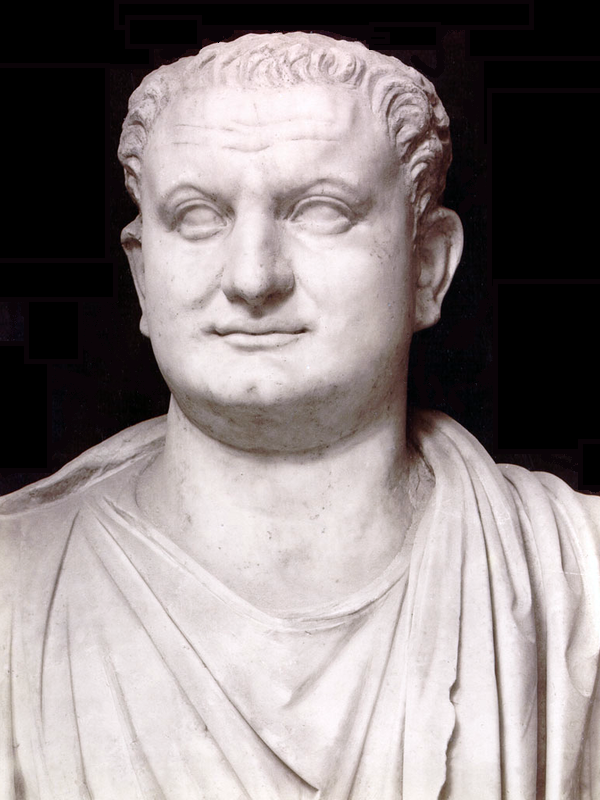
Bust of the emperor Titus