THE CRYSTAL SEA
Released: June 2024
Platforms: PC (Windows)
Team Size: Solo
Skill focus: Level design
Project Length: 4 weeks
Engine: Unreal Engine
Download and play the game on itch.io.
ABOUT THE GAME
The Crystal Sea is a short walking simulator focused on atmospheric storytelling and simple environmental puzzles. The game takes place in the aftermath of a devastating global winter that has reduced the Earth to a barren, frozen wasteland. Only a handful of humans survived the disaster, living inside a luxury space station suspended in orbit above the planet.
You take control of Vivian-3, an android sent by the survivors to the surface with instructions to reactivate a dormant deep space satellite. Once active, the satellite will provide them with critical data on potentially habitable exoplanets, finally allowing them to leave the solar system in search of a new home.
The satellite itself is perched atop the summit of a steep mountain, below which lies the astronomical research bunker once used to operate it. Your goal is to find a way inside and then gradually navigate your way up through each floor until reaching the summit, clearing a path through the snow and ice.
As the facility is slowly brought back online, you can begin to find data remnants contained within that share crucial information - details surrounding the catastrophic collapse of the global climate, the grim fate of the previous occupants of the facility, and the true nature of the human survivors that have sent you to the surface.
IMAGE GALLERY
DEVELOPMENT BACKGROUND
This game was a student project developed over four weeks as part of the level design unit at AIE. All 3D modelling, level geometry and visual effects had to be built from scratch inside Unreal Engine. This placed limitations on what I could achieve in a short timeframe but also helped to teach me a lot about the fundamentals of level design.
When approaching this project, my goal was to design a level that would require the player to progress in a mostly linear fashion by solving simple environmental puzzles. These puzzles would involve locating an item, such as a blowtorch, and using it open up previously inaccessible areas (by melting snow or ice). From here I could structure the level around each floor, allowing for separate puzzles to be designed for each. By exploring the facility, the player would naturally progress through each floor in a sequential order until eventually reaching the summit.
However, I also wanted to reward players for exploration and curiosity, so I designed each floor to include several hidden areas that could be accessed using these same puzzle mechanics. These areas primarily contained additional text datapoints that gave extra depth to the game's backstory, helping the player to piece together the fate of the bunker's inhabitants, uncover information about the fatal collapse of the planet’s biosphere, and also shed light on the identity of the human survivors trapped in orbit.
Approaching the level design this way also provided for slight variations on how the player might progress. The main path requires locating power cells and installing them into electrical generators to reactivate different parts of the facility, and although only four are needed to progress the main path, there are actually six in total, scattered throughout the facility, including some found inside these hidden areas. This provides further incentive for exploration and opens up new ways of progressing through the facility.
Design Documentation
LEVEL DESIGN OVERVIEW
Full Map Layout
Base of Mountain
From their starting point at the base of the mountain, the player’s attention is drawn immediately to the large satellite dish at the summit, which acts a visual marker directing them upwards to their goal.
As the player moves forward, the main road leading up the side of the mountain becomes buried under heavy snow and prevents them from progressing further, forcing them to look for an alternative entrance to the bunker.
The entrance can be found by exploring three drainage pipes that appear to the player’s left, two of which are blocked by snow while the third offers a clear route in.
Entering this pipe forces the player to crouch, introducing this movement mechanic to the player early on.
Floor 1
Player enters Floor 1 through the drainage pipe and drops down into the water reservoir basin.
The stairway leading to Floor 2 is inaccessible due to being located inside an area locked by a powered door (marked in green).
Player must retrieve a power cell (4) from the storage rooms and plug it into one of the generators to open the door to the stairwell.
Areas marked in light blue are snowed in and inaccessible until the player acquires the blowtorch from Floor 2 which allows them to melt snow formations.
Player can return to Floor 1 with the blowtorch to open up new areas, revealing additional datapoints, though this is not necessary to complete the main objective.
Floor 2
Player enters Floor 2 through the stairwell. Attempting to continue up the stairs to Floor 3 is not possible due to the presence of thick snow blocking the path.
To clear the way, the player must retrieve a blowtorch (12) from the research lab that can melt away the snow.
The main corridor to the research lab is also blocked by snow, meaning the player has to find another way in. This forces the player to go through the dining room and out onto the balcony.
From the left side of the balcony, the exposed balcony of the research lab is visible in the player’s peripheral, allowing them to reach the lab.
After retrieving the blowtorch from the lab and clearing a path back through the frozen corridors, the player can now melt the snow in the stairwell and access the next floor.
Floor 3
Player enters Floor 3 from the stairwell and is directed into the huge control room. They must then log onto the satellite network by accessing one of the computers in the area.
Doing so requires gaining access from the server room, which must be reactivated first by installing the final power cell in the generator room.
Once the player accesses the computer and reboots the satellite network, they discover that the satellite dish is unresponsive to commands to realign its position.
Player must now ascend to the surface to investigate the satellite dish. This requires retrieving an ice axe (21) from the first floor which is needed to clear ice blocking the elevator shaft.
Summit
Player reaches the summit after scaling up the elevator shaft and travelling along the walkway to the satellite platform.
Interacting with the control panel rotates the satellite dish, realigning its position and allowing communication to be established with the human spaceship in orbit. This initiates the final dialogue and the ending to the level.
ART BIBLE
DESIGN PROCESS
I began by first sculpting the landscape, using the in-built landscaping tool for Unreal Engine, which made for a fast block out of a rugged, mountainous landscape. I also blocked out the basic shape of the satellite itself and the size of the platform at the summit.
I then moved onto greyboxing the interior of the bunker, starting with the first floor and then working my way up. This was accomplished with Unreal's cube grid tool, which proved an easy and effective tool for blocking out interior spaces.
Early greybox for the mountain landscape and satellite dish
Early greybox for the interior of the facility, located inside the mountain
Next, I began to block out the meshes for all the 3D models that would be needed for the level. These were all created in engine using Unreal's in-built modelling tools. Use of reference images helped here greatly as I had little prior experience with 3D modelling.
I blocked out about two dozen different meshes in a few days. These included the satellite (arm, dish and base), ice axe and blowtorch, light fixtures, snow and ice formations, power cell and generator, various indoor furniture, a futuristic vehicle model, computer terminals, and various bathroom utilities (including shower, sink and toilet bowl).
An overview of all the 3D models I created for the project
With the basic level geometry done, I moved onto scripting, beginning with the basic interaction system for the player.
Next I tackled implementing functionality for all the level actors (opening doors, using elevators, powering generators, turning on lights).
After this I moved onto creating the two puzzle mechanics - melting snow with the blowtorch and smashing apart icicles with the ice axe.
Next I added some simple particle effects using Niagara - falling snow, the blowtorch's flame, and the ice fracture when struck with the ice axe.
I then wrote and implemented the text datapoints in the level, along with the widgets used to display them (see below under Datapoints for a more detailed breakdown on these).
Lastly, I scripted the end sequence and went to conduct final playtesting and bugfixes, while also attempting to add as much polish as possible with the time left.
Side by side comparison of the greyboxed level and the final version.
DESIGN CHALLENGES
One of the first major problems I had was how to achieve a convincing visual effect for the puzzle mechanics. I knew it would feel unsatisfying if these obstructions simply disappeared when interacted with, so I wanted to visually communicate to the player the tool being used.
To solve this problem, I added animation timelines that altered the mesh's level transform, helping to create a basic visual effect of the object being destroyed:
Snow piles lowered themselves down while gradually scaling down at the same time, giving the impression that the snow was melting into the floor.
Icicles scale themselves down with each hit from the ice axe, eventually creating enough space for the player to move past.
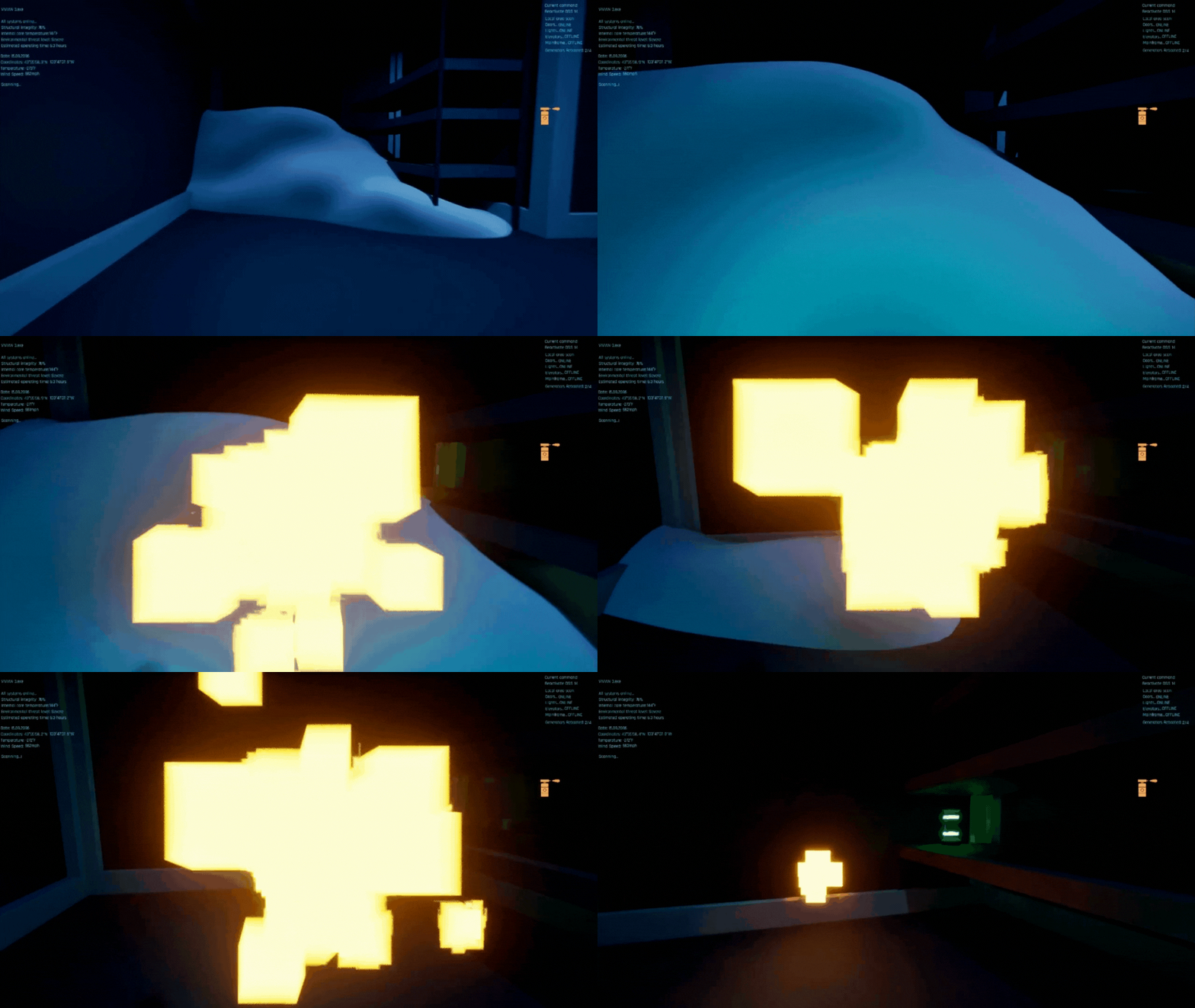
Snow melt effect when using blowtorch
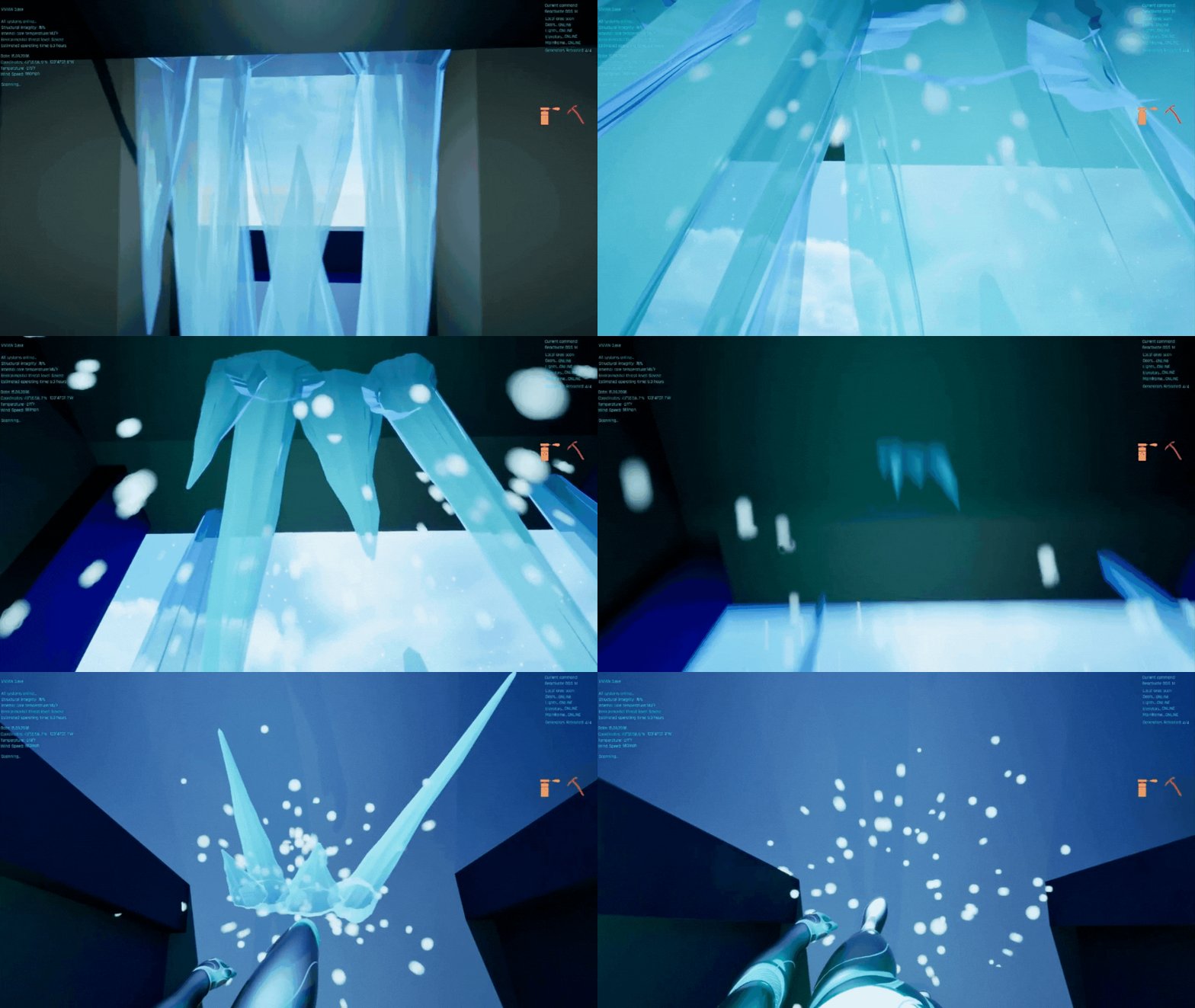
Ice break effect from using the ice axe
Designing the environment also presented several problems. The first was how to hide the horizon from player view so the exterior landscape looked as believable as possible. From the ground level this wasn’t an issue, as the surrounding landscape easily obscured the horizon. However, once the player reached the summit, this illusion would be broken as they could see beyond the mountains.
To fix this, I raised the level's fog layer while also increasing its density, completely covering the mountains. I then added triggers that would deactivate/reactivate the height fog when entering/exiting the bunker, so the interior spaces did not also become consumed by this dense fog layer.
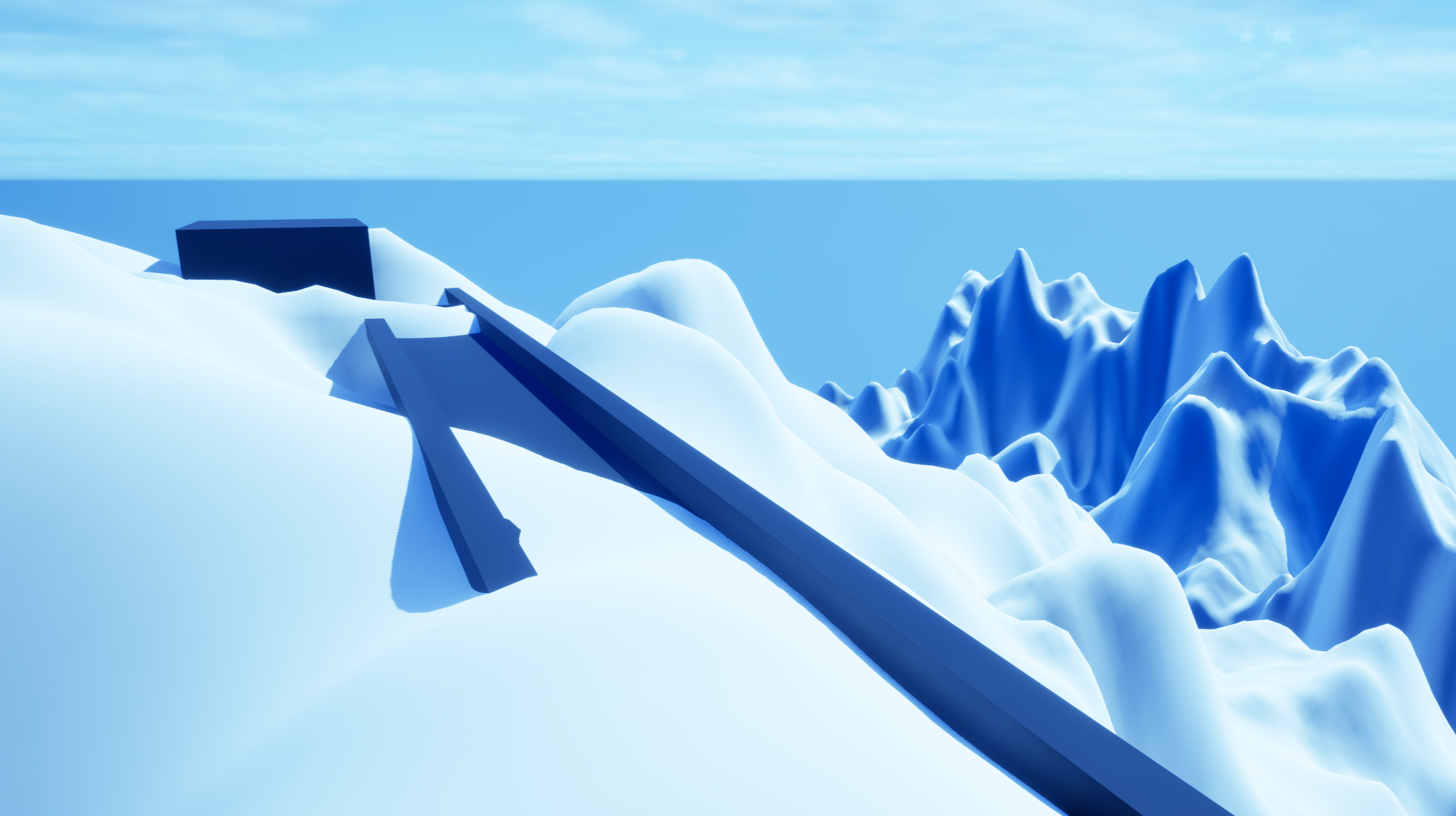
Default height fog, which exposes the horizon from the summit.
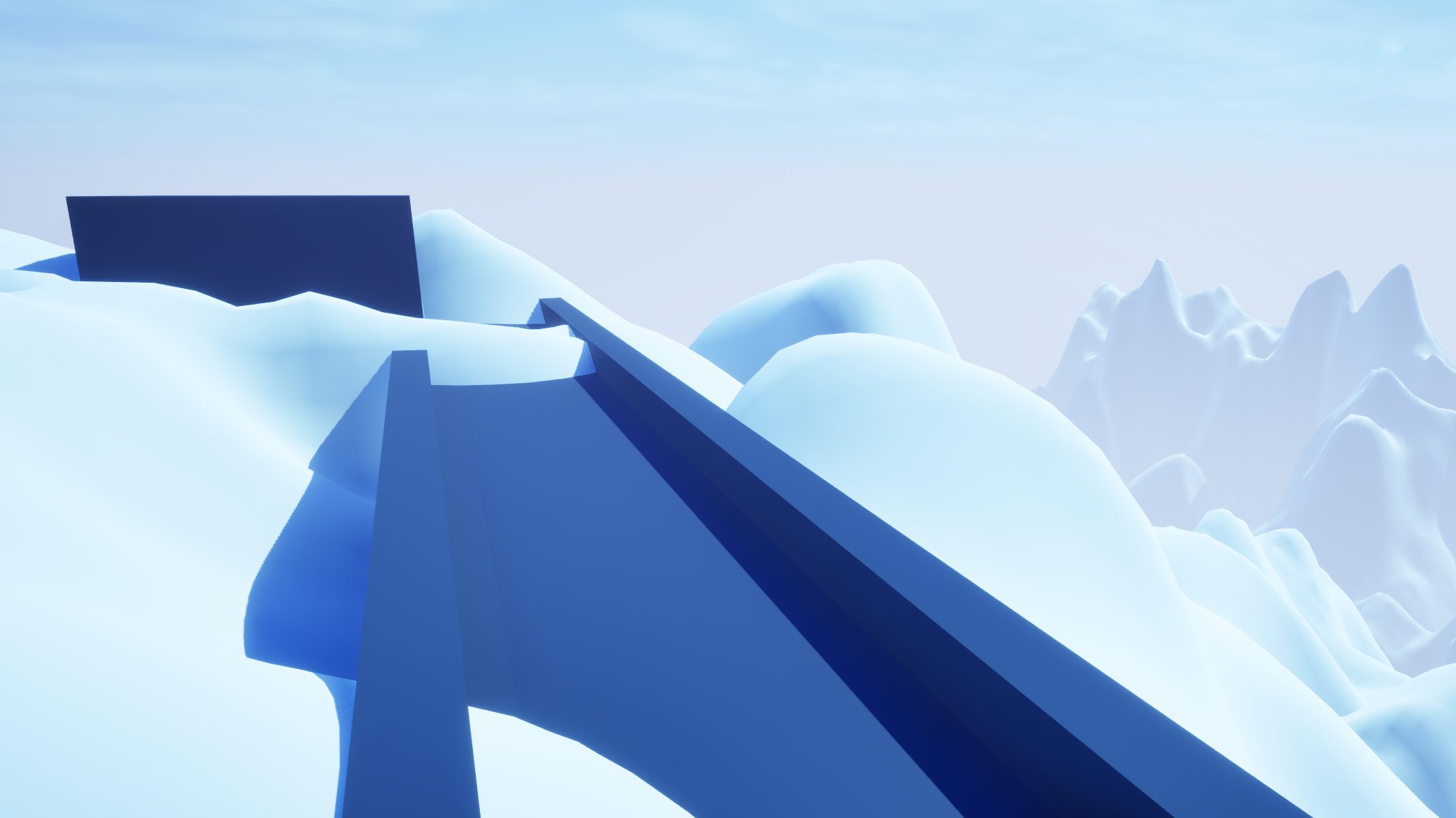
Updated height fog, obscuring the horizon from the summit.
The other issue with environmental design was the snowfall effect. Initially the snow particle effect I created with Niagara was used to envelop the entire landscape, but this badly affected performance due to the sheer volume of particles. I wanted the level to have an intense blizzard affect to stress the harshness of the climate catastrophe, so I couldn't reduce the volume of snow particles.
To solve this problem, I attached the particle effect to the player character so it would move with them, allowing it to be greatly reduced in size while still giving the same impression as before of being trapped in a snowstorm. I then used triggers to deactivate the particle effect whenever the player went inside.
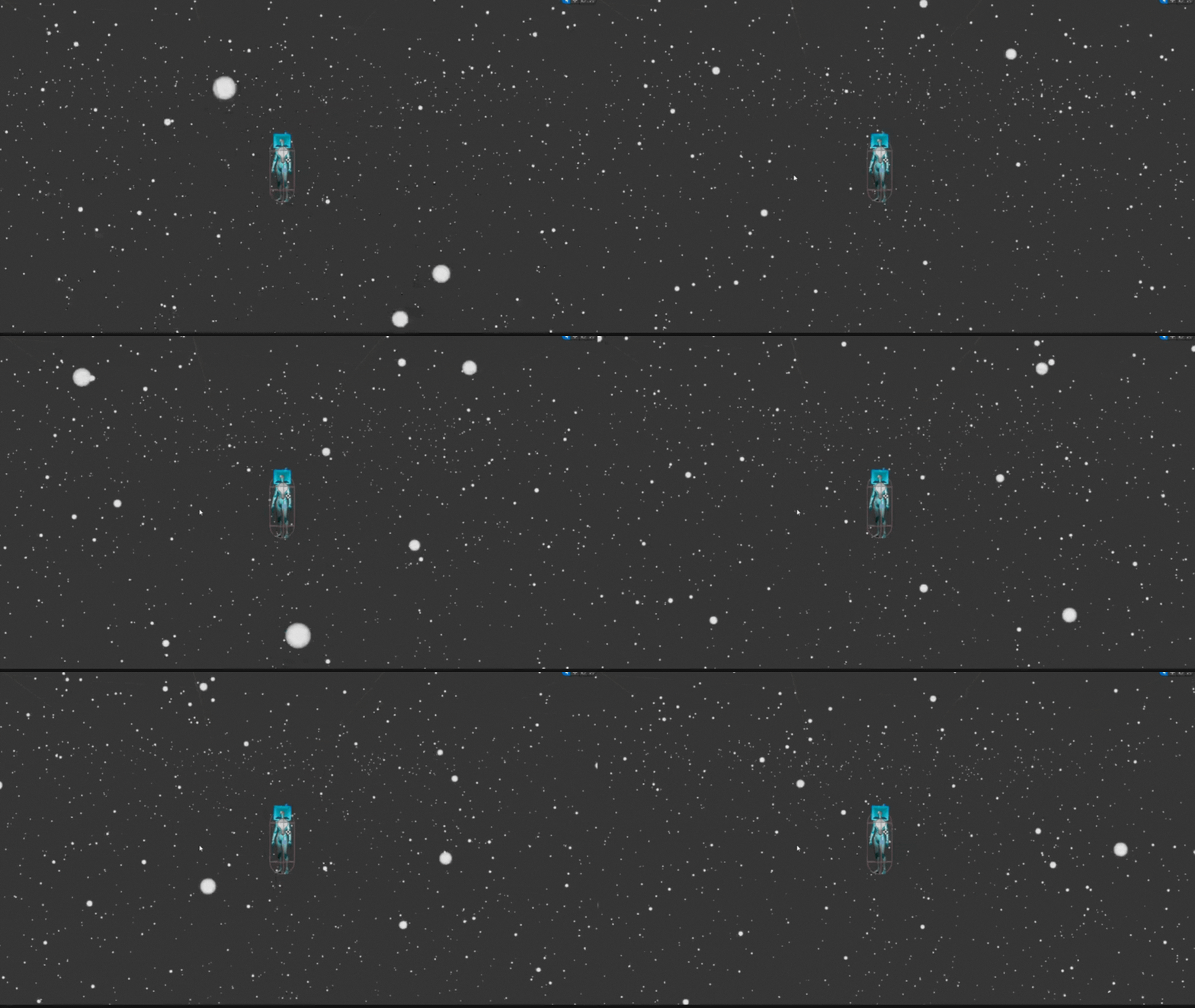
Snowfall niagara system is attached to the player character blueprint
View from above the player, showing the localised snowfall surrounding them.
DATAPOINTS
Datapoint 01: WMO: State of the Global Climate 2091
January 6, 2091
The World Meteorological Organization reports that global temperatures will continue to fall this year, continuing the trend from the previous decade. Estimates indicate that the average global temperature will decrease by another 1.6 degrees Celsius by the end of 2091, the most extreme drop since the 1812 "Year Without a Summer" that reduced global temperature by approximately 0.7 degrees. The UN is warning major agricultural regions to brace for another harsh winter amid fears of a potential disruption to global food supply.
This datapoint was written as an excerpt from a report by the World Meteorological Organisation (WMO), which publishes annual climate reports. By including the year (2091), the player learns roughly how far into the future the game is set. It also provides an insight into the early days of the climate catastrophe, foreshadowing how much the crisis will worsen from here on. For this reason it was intended to be the first datapoint the player finds, and so was placed in the generator room, the first area they reach after entering the facility.
Datapoint 02: Inside the Golden Seraph, the trillion dollar luxury orbital palace you'll never visit
Time magazine, April 2088
How much again for a night? The Golden Seraph is preparing to launch the first of its planned modules into orbit this year. By the project's end it will feature 150 private suites, 16 swimming pools, 5 theatres, 7 360 degree orbital viewing decks, 5 casinos, 12 restaurants, 33 cafes and 3 entire shopping malls. Fully enclosed public parks span the length of its eastern wing, providing the vast majority of its oxygen supply, while water is fully cleaned and recycled through an enormously complex system of pipes, reservoirs and filtration systems.
However, this is not somewhere you can book in, even months in advance. Every spot is reserved only for those who can pass a certain wealth threshold, and the waiting list even there goes on. Exactly how much does it cost to get in? Well, corporate owner Ion Technologies remains tight-lipped about entry requirements, but the impression we get is that if you're not part of the 1%'s 1%, don't even bother asking.
This datapoint was written as a news report about the opening of an luxury space station for the ultrawealthy. It is located in a hidden area, so the player will need to explore thoroughly to find it, and they are rewarded for this as it contains valuable story information. The report is dated to April 2088, so the player knows it predates the climate collapse. It is meant to provide a small glimpse into society before the global winter, but more importantly to explain where the current human survivors came from - they are revealed to be the same wealthy elite that avoided perishing from the cold due to their habitation on the Golden Seraph resort.
The "Golden Seraph" is specifically namedropped here, so that during the end sequence when the player makes contact with a Golden Seraph radio operator they will realise where the signal has come from and who they are communicating with. This revelation was also meant to complicate the player's motivations, as they are revealed to be the servant of an amoral rich elite that allowed the Earth's population to perish while they lived in luxury above the planet, yet are now seeking to save their own lives.
Datapoint 03: Percent of habitable land on Earth drops to 13%
Associated Press, 5 November 2092
Amid plummeting global temperate levels, the overall percentage of habitable land on Earth has now reached its lowest point in recorded human history, an astonishing decrease of more than 30% over the past two years. In North America, the Canadian cities of Toronto, Montreal and Vancouver had experienced rapid depopulation as waves of climate refugees flee south towards warmer areas in the central United States.
In Europe, the channel tunnel remains backed up since early October as millions of British citizens look for a way off their freezing island. Australia, South Africa and the Persian Gulf have faced the largest waves of migration, but temperatures continue to drop there also, and show no signs of slowing down.
Meanwhile, the net reduction in the global population continues to grow, as thousands perish every day across the world from extreme cold, with the estimated death toll nearing 500 million, more than five times that of the deadliest epidemics in history. Current climate prediction models estimate that the entire surface area of the planet will become uninhabitable within five to ten years, leaving world leaders increasingly desperate for a solution.
Another news report, this one dated to 2092. When cross-referenced with the WMO's 2091 report, it indicates how quickly the climate has deteriorated in just two years. This datapoint was designed to highlight the truly catastrophic nature of the climate crisis and how hopeless the situation was for everyone on Earth.
Datapoint 04: Major breakthrough in cryostasis may allow humans to endure deep space travel
Smithsonian, 15 June 2086
A major breakthrough in cryonic research undertaken by researchers at MIT appear to have solved one of the most persistent issues with the field - how to keep the body alive while frozen? Dr Samuel Templeton believes his team have found the answer. There are still kinks to be worked out, such as how to automate the process, which would require advancements in artificial intelligence and investment in longer lasting fuel sources, but Templeton believes that such a massive stride in technology would enable humans to place themselves in suspended animation for potentially hundreds, if not thousands of years, opening the doorway to deep space voyages.
"While faster than light travel remains outside our grasp, we may be nearing a point where we can dispatch cryogenically frozen humans into deep space that can be safely thawed out thousands of years down the line, ready to began the process of colonizing distant planets. It's a very exciting moment in the history of our species. No more shall we be sending out hopeful radio signals and unmanned probes into the void, still stuck on our lonely rock. We will be stepping forth to see what's out there for real.
The purpose of this datapoint was to provide context for the player's actions and by extension the goals of the human survivors. The implication is that the Golden Seraph was in possession of this cryonic tech and would use it to survive the centuries long journey to a new habitable exoplanet - once that planet was located using the deep space satellite the player had reactivated.
Datapoint 05: Revelations 15: 1 - 6
After this I looked, and, behold, a door was opened in heaven: and the first voice which I heard was as it were of a trumpet talking with me; which said, Come up hither, and I will shew thee things which must be hereafter.
And immediately I was in the spirit: and, behold, a throne was set in heaven, and one sat on the throne.
And he that sat was to look upon like a jasper and a sardine stone: and there was a rainbow round about the throne, in sight like unto an emerald.
And round about the throne were four and twenty seats: and upon the seats I saw four and twenty elders sitting, clothed in white raiment; and they had on their heads crowns of gold.
And out of the throne proceeded lightnings and thunderings and voices: and there were seven lamps of fire burning before the throne, which are the seven Spirits of God.
And before the throne there was a sea of glass like unto crystal: and in the midst of the throne, and round about the throne, were four beasts full of eyes before and behind.
This is an excerpt from the Book of Revelations, which provides the source for the game's title ("there was a sea of glass like unto crystal"). I chose this name as a reference to the sea of ice crystals that now enveloped the globe, but through this Bible verse it was also intended to invoke ideas of hubris. The survivors on the Golden Seraph (itself another Biblical reference to the highest order of angels), were attempting to transcend their human condition, living outside the bounds of the earth in artificial confinement, attempting to cheat death and overcome their mortality.
Datapoint 06: Letter of Cassiodorus
"Since the world is not governed by chance, but by a Divine Ruler who does not change His purposes at random, men are alarmed, and naturally alarmed, at the extraordinary signs in the heavens, and ask with anxious hearts what events these may portend. The Sun, first of stars, seems to have lost his wonted light, and appears of a bluish colour. We marvel to see no shadows of our bodies at noon, to feel the mighty vigour of his heat wasted into feebleness, and the phenomena which accompany a transitory eclipse prolonged through a whole year.
We have had a winter without storms, a spring without mildness, and a summer without heat. Whence can we look for harvest, since the months which should have been maturing the corn have been chilled by Boreas? How can the blade open if rain, the mother of all fertility, is denied to it? These two influences, prolonged frost and unseasonable drought, must be adverse to all things that grow.
The middle air is thickened by the rigour of snow and rarefied by the beams of the Sun. This is the great Inane, roaming between the heavens and the earth. When it happens to be pure and lighted up by the rays of the sun it opens out its true aspect; but when alien elements are blended with it, it is stretched like a hide across the sky, and suffers neither the true colours of the heavenly bodies to appear nor their proper warmth to penetrate."
Letter written by Roman Praetorian Prefect Cassiodorus, c. 536 AD
This datapoint is an excerpt from the letters of Roman statesman Cassiodorus, describing the volcanic winter that began in 536 AD. This event devastated the Northern Hemisphere, triggering widespread crop failures and mass death from the resulting famine and drop in temperatures. I included this partly as interesting historical detail but also to imply that the game's setting is essentially a more severe example of this taking place in the future.
Datapoint 07: Darkness
I had a dream, which was not all a dream.
The bright sun was extinguish'd, and the stars
Did wander darkling in the eternal space,
Rayless, and pathless, and the icy earth
Swung blind and blackening in the moonless air;
Morn came and went—and came, and brought no day,
And men forgot their passions in the dread
Of this their desolation; and all hearts
Were chill'd into a selfish prayer for light:
And they did live by watchfires—and the thrones,
The palaces of crowned kings—the huts,
The habitations of all things which dwell,
Were burnt for beacons; cities were consum'd,
And men were gather'd round their blazing homes
To look once more into each other's face;
Happy were those who dwelt within the eye
Of the volcanos, and their mountain-torch:
A fearful hope was all the world contain'd;
Forests were set on fire—but hour by hour
They fell and faded—and the crackling trunks
Extinguish'd with a crash—and all was black.
Excerpt from poem "Darkness" by Lord Byron, 1812
This poem was written in 1812, the infamous "Year Without a Summer", describing a similar climate crisis as the 536 AD event that wreaked havoc across the globe. This datapoint largely serves the same purpose as the previous one, providing insight into the harsh realities of the world the player now finds themselves in.
Datapoint 08: Evacuation timeline
From: Jakob Erebson (jerebson@nasa.gov)
To: dss14station.all@nasa.gov
Date: 10 June 2092, 10:33 am
Hello everyone,
Following the final conferencing with NASA headquarters in Washington, this station will officially go offline by the end of the month. Thus it is with a heavy heart that we must power down the last satellite dish that still communicates with the DSN, forever severing the faint links with the handful of distant manmade probes out there in deep space.
As concerns us here, by that point, all external electricity supplies will be cut off. Our backup generators have enough fuel to power essential systems for another six to eight weeks, during which time a skeleton crew will remain in place to oversee the gradual deactivation of the facility. The rest of the station will be steadily evacuated over the next two weeks with most of us relocating to Rapid City once the snow blocking the main road has been cleared, allowing buses and trucks to make it up the mountain. If you like to arrange private transport, please inform the station manager.
This datapoint was designed to offer context regarding the facility itself, identifying it as a deep space research station for NASA. It also provides insight on the crisis faced by the station's inhabitants: with the extreme drop in temperature, life inside the facility had become impossible and they were being forced to evacuate. The facility's location is also revealed to be South Dakota by the namedrop of Rapid City, and the reference to abundant snowfall despite the email being dated to mid June (summertime in the Northern Hemisphere), reveals how severe the climate crisis has become.
Datapoint 09: Voicemail recording, dated Wednesday, 7th December 2091
"Hi, honey. I hope you're keeping warm over there. Unfortunately the temperatures up here are still too low for us to make a safe descent, and weather reports show that won't be changing anytime soon. They tried to organise flights out but the winds are far too strong and visibility too poor to risk sending helicopters up. I'm sorry to say but I won't be able to make it back for Christmas this year. I know that's going to be hard on you, but times are tough and scary right now and the most important thing is that we stay safe and ride out this storm best we can. Lots of love, Mom."
Voicemail recorded Wednesday, 7 December 2091
This datapoint was designed to highlight the increasingly dire situation faced by the bunker's inhabitants, as the climate abnormalities had become so severe that evacuation itself became too risky, leaving them trapped on the mountain with no signs of the temperature drop reversing.
Datapoint 10: 4th of July drinks
From: Isaak Rayner (irayner@nasa.gov)
To: dss14station.all@nasa.gov
Date: 4 July 2093, 8:21 am
Hi all,
With the rising snow levels and lack of leads opening up this summer, any possibility of evacuation vehicles reaching us before the fall season is gone. Wind speeds have already made it far too dangerous for any helicopters to make the trek up. Our final supply drop of food and medicine has included 22 vials of hydrocyanic acid, liquid soluble. We'll be having a final 4th of July drinks in the dining hall tonight if you'd like to join us.
This final datapoint reveals the grim fate of the facility's inhabitants. Dated to July 2093, they have become completely frozen in with no hope of rescue. The reference to hydrocyanic acid (cyanide) shows that they have been given the choice of ending their lives quickly and painlessly rather than face death by starvation and cold.
POST MORTEM
This was my first major experience with designing and building a 3D environment inside Unreal Engine, and it taught me a lot about the process of level design and its potential pitfalls.
The size and scale of the level was certainly over scoped given the project limitations, which forced me to remove several planned sections of the facility, and much of the remaining area was left feeling empty.
What I learned here was that the more you increase the scope of the level environment, the more you reduce the ability to flesh it out with detail, particularly when you have a tight project deadline.
This was especially true here as every environment prop had to be modelled from scratch, and I quickly realised that to populate the bunker with enough detail I would need to create many more 3D models than I had the time or resources for.
Despite these issues, I was still pleased with what I was able to accomplish in such a short timeframe.